If you live in New York City, you already know that the real estate market is less of an economy and more of an extreme sport. Between the bidding wars, the astronomical broker fees, and the sheer disbelief of handing over half your paycheck for a fifth-floor walk-up with a bathtub in the kitchen, finding a place to live is exhausting. You might have heard whispers of a mythical alternative at a dinner party or in a Reddit thread—a magical portal where regular people score gorgeous, brand-new, rent-stabilized apartments for a fraction of the market rate.
That portal is real. It’s called NYC Housing Connect.
But let’s be entirely honest from the jump: NYC Housing Connect is not a quick fix for an expiring lease. It is a slow, bureaucratic, deeply complex system that requires patience, fastidious record-keeping, and a healthy dose of pure luck. However, for those who crack the code and finally get handed the keys, it is nothing short of life-changing.
Whether you are a barista making $35,000 a year or a software engineer making $130,000 a year, there might be a spot in this system for you. Yes, you read that right—affordable housing in NYC covers a surprisingly massive income spectrum. In this comprehensive, 2000+ word guide, we are going to break down exactly what NYC Housing Connect is, how the incredibly confusing income metrics work, how to build a bulletproof profile, and how to survive the grueling audit process if your number finally gets pulled.
What Exactly is NYC Housing Connect?
NYC Housing Connect is the centralized online portal managed by the NYC Department of Housing Preservation and Development (HPD) and the Housing Development Corporation (HDC). Simply put, it is the city’s official marketplace for affordable housing lotteries.
There is a persistent, outdated misconception that “affordable housing” exclusively means older, city-run public housing projects. While the New York City Housing Authority (NYCHA) handles public housing, NYC Housing Connect is entirely different. Most of the apartments listed on this portal are located inside brand-new, state-of-the-art luxury developments.
How does that work? It comes down to a zoning policy called Mandatory Inclusionary Housing (MIH), alongside various tax incentive programs. When developers want to build a shiny new high-rise in Brooklyn, Queens, or Manhattan, the city often requires them to set aside a certain percentage of the units (usually around 20% to 30%) as permanently affordable. In exchange for massive tax breaks, the developer hands the leasing process for those specific units over to the city’s lottery system.
Through Housing Connect, you can apply for:
- New Rental Lotteries: Brand-new buildings leasing up for the very first time.
- Re-rentals: Vacancies that open up when a previous lottery winner moves out of an older building.
- Affordable Homeownership: Rare, but highly coveted, opportunities to buy co-ops or condos at deeply restricted prices (with strict resale caps).
In 2020, the city launched “Housing Connect 2.0,” a much-needed overhaul of the old, clunky legacy system. Today, the platform is more streamlined, mobile-friendly, and accessible (including screen-reader compatibility and integrated NYC.ID logins), but the sheer volume of applicants means the competition is fiercer than ever.
The Golden Metric: Understanding Area Median Income (AMI)
If you take nothing else away from this guide, you must understand the concept of Area Median Income (AMI). It is the absolute beating heart of the NYC Housing Connect system.
AMI is a metric set annually by the federal Department of Housing and Urban Development (HUD). It calculates the midpoint of the region’s income distribution. In a high-cost metropolitan area like New York City, the AMI is staggering. For example, by 2025/2026, the 100% AMI for a family of four in the NYC region hovers around $162,000.
Every single apartment on Housing Connect is assigned an “AMI band.” To be eligible for that specific apartment, your household income must fall within that exact band. The bands usually look like this:
- 30% AMI (Extremely Low Income): Designed for minimum-wage workers, part-time employees, or those on fixed incomes. A single person might need to make between $18,000 and $28,000 to qualify. Rent can be as low as $400 to $600 a month.
- 50% – 60% AMI (Very Low Income): Often the sweet spot for entry-level workers, teachers, and non-profit employees.
- 80% AMI (Low Income): A common tier for moderate earners. A single person making around $75,000 might fit perfectly here.
- 130% to 165% AMI (Middle Income): This is where people get confused and sometimes angry. You will see lotteries on the portal where the required income is $120,000, and the rent is $3,000 a month. People often ask, “How is this affordable housing?” The reality is that the city uses these middle-income tiers to subsidize the lower-income tiers within the same building. While a $3,000 rent isn’t cheap, it is permanently rent-stabilized. In a market where landlords routinely hike rents by $500 a year, knowing your rent can only go up by the small, legally allowed Rent Guidelines Board percentage (usually 1% to 3%) is a massive financial safety net.
The Income Catch-22
Your income must be above the minimum limit to prove you can afford the rent, but below the maximum limit to prove you actually need the affordable unit. If you make $1 below the minimum, you are rejected for being “under-income.” If you make $1 above the maximum, you are rejected for being “over-income.”
Your AMI is also inherently tied to your Household Size. The more people in your household, the higher the income limit is for a specific AMI band. A single person making $90,000 might be over-income for a 60% AMI unit, but a family of three making that exact same combined $90,000 might qualify perfectly.
Who is Eligible? (And Who Gets Preference)
Anyone who is at least 18 years old can apply for NYC Housing Connect, including out-of-state residents. However, the system is fundamentally designed to serve New Yorkers, and it uses a strict preference system that dictates who gets called first.
When a lottery closes, all applications are scrambled and assigned a randomized “Log Number.” But before they just call number 1, 2, and 3, they filter the list based on preferences. If you hold a preference, your application is pulled to the front of the line.
1. The Disability Set-Aside (7% of units):
By law, new affordable housing constructions must set aside a specific percentage of units for applicants with disabilities.
- 5% for Mobility Impairments: These units have lowered counters, roll-in showers, and wider doorways.
- 2% for Vision and Hearing Impairments: These units feature visual alarms, smart appliances, and tactile modifications.
2. The Community Board Preference (Up to 50% of units):
This is the most powerful—and currently the most controversial—preference. Historically, half of the affordable units in a new building are reserved for people who already live in the specific Community Board district where the building is located. The logic is to prevent displacement and gentrification, ensuring long-time neighborhood residents get a chance to stay. (Note: This preference has faced intense legal challenges in recent years, but living in the same zip code as a lottery building still generally provides a massive statistical advantage).
3. Municipal Employee Preference (5% of units):
Reserved for full-time employees of the City of New York (e.g., sanitation workers, NYPD, FDNY, public school teachers, city agency staff).
4. The NYC Resident Preference:
After the specific community board and disability preferences are exhausted, priority is given to current residents of the five boroughs over anyone applying from out of town.
What About Assets?
It’s not just about what you earn; it’s about what you own. You cannot be a millionaire on paper who just happens to have a low annual salary.
For rental units, the household asset limit is typically equal to the maximum income limit for a four-person household at the AMI level of the unit. (For example, if the 4-person limit is $150,000, you cannot have more than $150,000 in liquid assets). For homeownership programs, the asset limit is usually capped at 175% of the AMI. Assets include checking accounts, savings accounts, investment portfolios, cryptocurrency, and real estate. Note: Retirement accounts (like a 401k or IRA) are generally excluded from this calculation, but the interest/dividends might be counted as income.
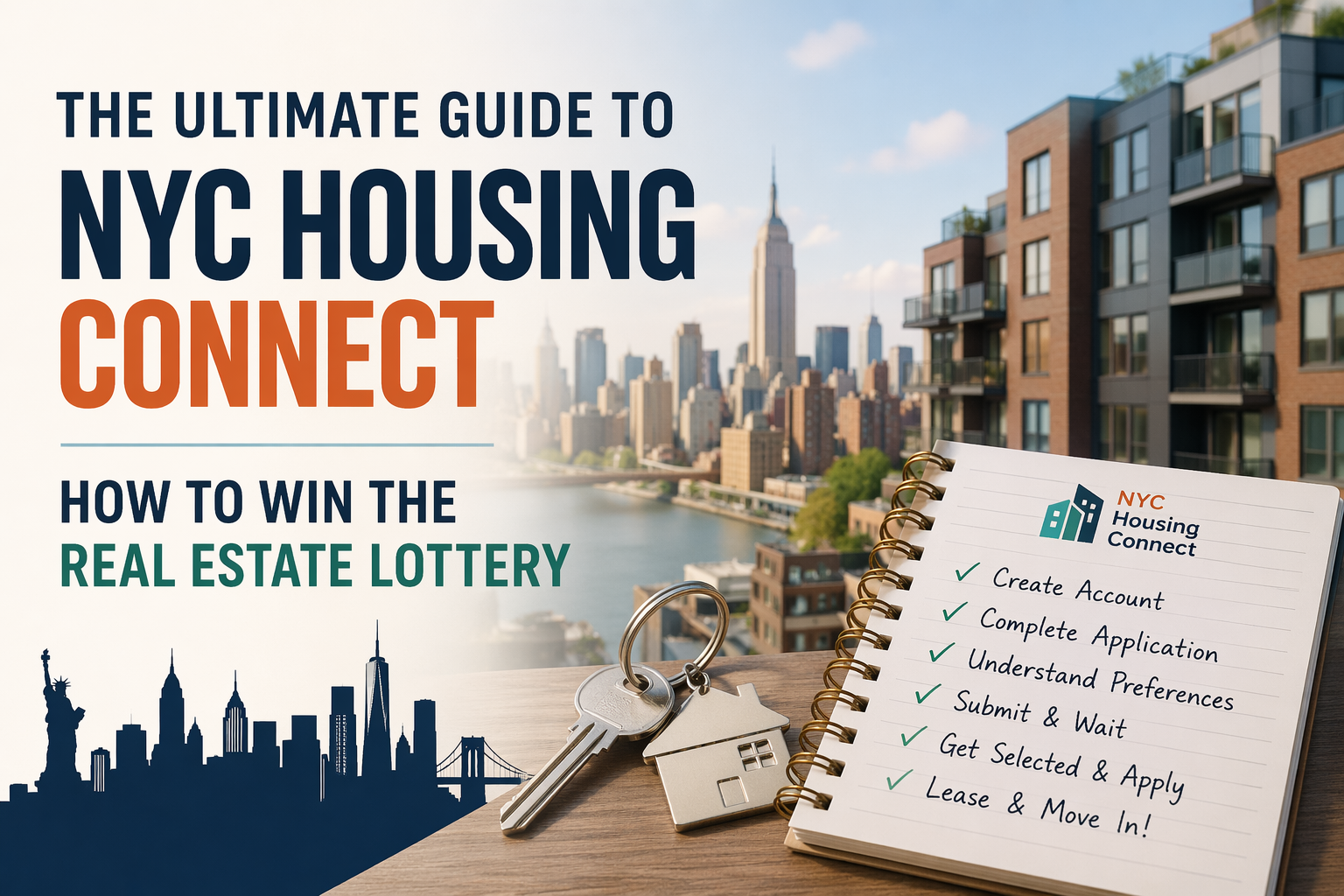
Step-by-Step: Setting Up Your Profile for Success
Your Housing Connect profile is your digital resume. If it is inaccurate, you will be rejected later. Take the time to get this exactly right.
Step 1: Account Creation
You will log in using an NYC.ID. Make sure the primary email address you use is one you check obsessively. When a developer reaches out, they usually give you a very tight window (sometimes just 5 days) to respond. If it goes to your spam folder, you lose the apartment.
Step 2: Household Composition
You must list every single person who will physically live in the apartment with you. This includes roommates, spouses, children, and elderly dependents. You cannot apply as a single person to get a lower income bracket, and then magically move your partner in the day after you sign the lease. The city requires birth certificates and IDs for every member.
Step 3: Income Reporting (The Danger Zone)
This is where 90% of applicants mess up. You must project your income for the upcoming 12 months, not just what you made last year.
- W-2 Employees: Take your current gross weekly pay and multiply it by 52. Do not use your net (take-home) pay. Do not guess. Look at your paystub. Include expected bonuses.
- Freelancers and Gig Workers (1099): If you drive for Uber, do freelance graphic design, or run an Etsy shop, the rules are slightly different. The city will look at your Net income (Gross receipts minus allowable business expenses) from your previous tax returns, usually averaging the last two to three years to project your future income.
- Benefits: You must declare unemployment benefits, child support, alimony, SSI, and SSDI.
Step 4: Keep It Updated
Life happens. You get a promotion. You get laid off. You have a child. You must update your Housing Connect profile the moment your circumstances change. When you apply for a lottery, the system takes a “snapshot” of your profile at that exact moment. If you get selected six months later and your actual income doesn’t match the snapshot you applied with, you are in for a very difficult appeal process.
The Lottery Process: What Happens After You Click Apply?
Once your profile is sparkling and accurate, go to the “Open Lotteries” tab. Filter by your borough preferences and apply to everything where your income fits the designated AMI band.
Then? You wait. And wait. And wait some more.
When a lottery closes, the city generates a randomized list of applicants. You are assigned a Log Number.
- If a building has 50 affordable units, and your log number is 23, pop the champagne. You are virtually guaranteed an interview.
- If your log number is 2,500, you have a decent chance, as many people ahead of you will drop out or be disqualified.
- If your log number is 65,000… forget about it and move on to the next lottery.
In recent years, the lease-up process has been heavily criticized for severe delays. A 2026 case study by the New York Housing Conference noted that in some buildings, tens of thousands of applications were batched for just a hundred units, and redundant city inspections caused renters to wait months to move in. You must maintain your current living situation while waiting for Housing Connect; never break a lease early just because you got a low log number.
You Got Selected! The Document Request and Interview Phase
One Tuesday afternoon, you will get an email that makes your heart stop. It will say: “You have been selected for further processing…”
Do not celebrate yet. You have just entered the gauntlet. The developer’s marketing agent now has to prove to the city that you aren’t lying about a single thing on your profile. They will ask for a mountain of documentation, usually requiring you to upload it within 5 to 14 days.
Prepare these documents well before you ever get an email:
- Tax Returns: The last two to three years of complete federal and state tax returns, including all schedules.
- Pay Stubs: Your last six consecutive pay stubs. If you are paid weekly, you need the last six weeks. If you miss even one, they will halt your application.
- Letter from Employer: A signed, notarized letter on company letterhead confirming your start date, title, hourly/salary rate, and expected annual earnings.
- Bank Statements: The last six months of checking and savings account statements. Warning: They read every line. If they see a random $500 Zelle deposit from a friend, they will make you sign a notarized affidavit explaining exactly what that money was for, to ensure it isn’t “hidden, off-the-books income.”
- Proof of Rent Payments: Because the city updated rules to help those with poor credit, landlords can no longer reject you solely based on a low credit score if you can prove you have paid your current rent on time, in full, for the last 12 consecutive months. You will need rent ledgers, canceled checks, or bank statements proving this.
- Identification: Birth certificates, social security cards, and state IDs for everyone in the household.
During this phase, an agent will mathematically dissect your life. If you stated you make $60,000, but your six pay stubs average out to a pace of $62,000, and the AMI cutoff is $61,500, they will reject you. The scrutiny is intense, invasive, and exhausting.
Common Pitfalls and Why People Get Rejected
The rejection rate in the document phase is astronomically high—sometimes up to 80% of applicants who are called are eventually disqualified. Here is why:
- The Over-Income Trap: This is the most painful one. You applied in January when you were making $70,000. The developer calls you in October. In August, you got a $5,000 raise. That raise pushed you over the AMI limit. You are disqualified. The city does not care what you made when you applied; they care what you are making at the exact moment you sign the lease.
- The Under-Income Trap: Conversely, if you lose your job while waiting for the lottery, you might suddenly fall below the minimum income required to pay the rent. Unless you have a Section 8 or CityFHEPS voucher to cover the difference, you will be rejected.
- The Ghost Applicant: The email went to spam, and you missed the 5-day window to upload your W-2s. You are automatically disqualified for non-responsiveness.
- The Untraceable Cash: If you work in nightlife, hospitality, or the gig economy and cannot provide a clear paper trail (tax returns, organized ledgers) for your cash tips or freelance income, the agent cannot legally verify your income, leading to an automatic rejection.
Fighting Back: The Appeal Process
If you receive a rejection letter, it is not necessarily the end of the road. You have the right to appeal the decision, typically within 14 business days of receiving the notice.
You must read the rejection letter carefully to understand exactly why you were denied.
- If they rejected you for being over-income because they counted a one-time $2,000 bonus as recurring weekly pay, you can appeal. You will need to get a letter from your HR department explicitly stating the bonus was a one-time, non-recurring event.
- If you were rejected due to a negative credit history, you can appeal by immediately providing 12 months of flawless rent payment history to override the credit check.
Write a clear, concise letter addressing the exact reason for rejection, attach the irrefutable proof, and submit it through the portal. If the developer denies your appeal, you can escalate it to the HPD or HDC directly as a final resort. Many people who are initially rejected go on to win their appeals simply by providing the missing context.
Conclusion: It’s a Marathon, Not a Sprint
Navigating NYC Housing Connect is akin to taking on a part-time job. It requires vigilance, supreme organizational skills, and a willingness to bare your entire financial soul to a stranger in a leasing office.
Do not rely on Housing Connect as an immediate solution to a housing crisis. Treat it like a long-term investment. Keep your profile updated every time you get a raise or change jobs. Apply to every lottery you qualify for, even if it’s a neighborhood you hadn’t previously considered. Check your spam folder religiously. Keep a digital folder on your desktop with your tax returns and pay stubs ready to go at a moment’s notice.
The system is flawed, the wait times are agonizing, and the bureaucracy can be maddening. But the day you sign a lease for a gorgeous, rent-stabilized apartment that you can actually afford, while overlooking the sprawling skyline of the greatest city in the world—you’ll realize every single tedious step was worth it. Keep applying, and may the log numbers be ever in your favor.