
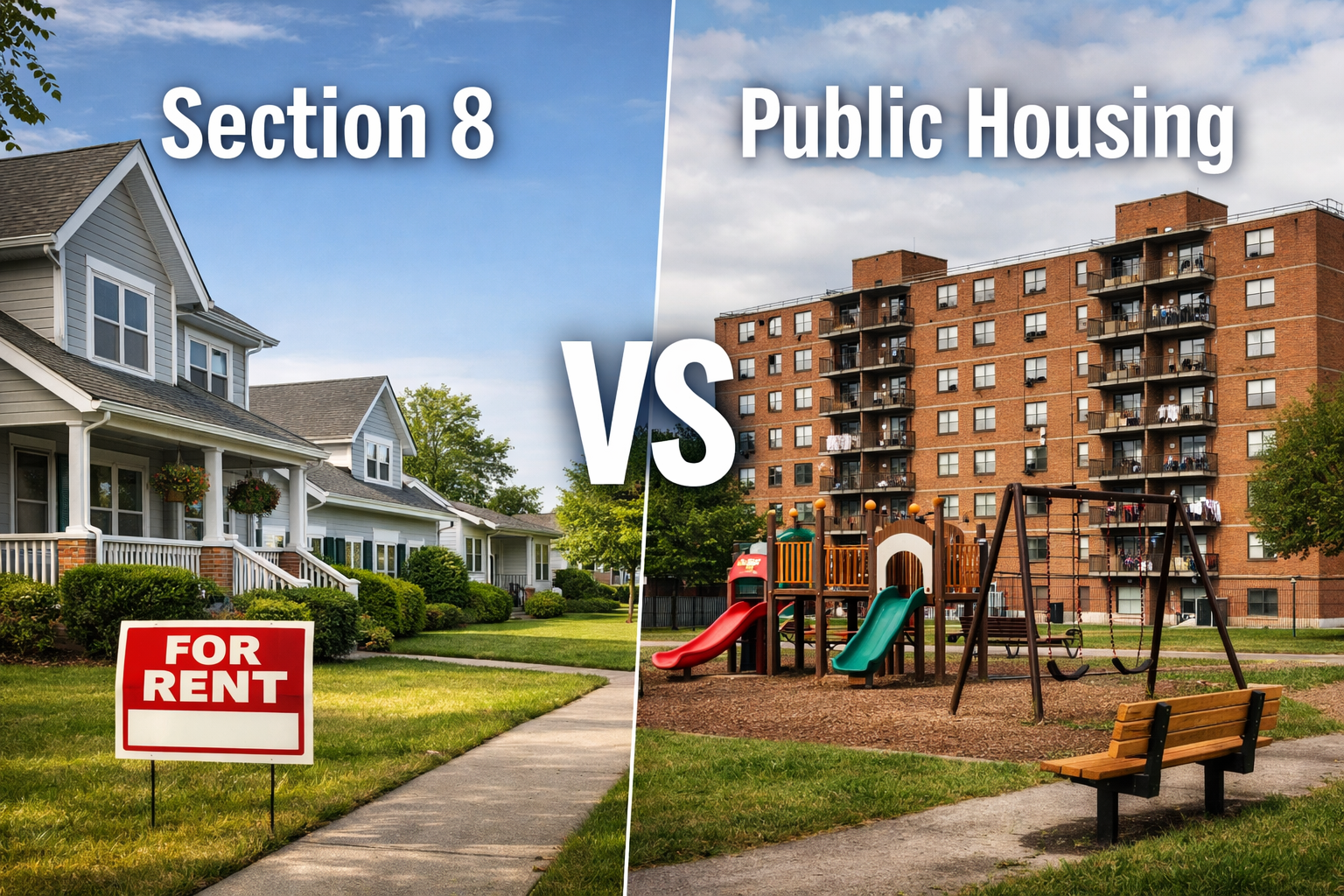
- Section 8 and Public Housing serve the same goal: making rental housing affordable for low-income households, but they do it in very different ways.
- Section 8 offers choice and mobility by subsidizing private-market rentals, allowing families to move across neighborhoods and even states.
- Public Housing provides stability through PHA-owned units with income-based rent, but tenants are tied to specific developments.
- Rent is income-based in both programs, typically around 30 percent of household income. Housing is subsidized, not free.
- Demand far exceeds supply for both programs, resulting in long waiting lists that often last years.
- Section 8 depends on landlord participation, which can limit housing options in tight rental markets.
- Public Housing faces chronic underfunding, leading to aging buildings and limited expansion of units.
- Neither program is “better” for everyone; the best option depends on a household’s need for mobility, stability, location, and available units.
Definitions and purpose
Section 8 – Housing Choice Voucher Program
Section 8, also called the Housing Choice Voucher Program, is the federal government’s primary rental assistance program created in the 1970s. It is often described as “the nation’s largest source of rental assistance.” Eligible low-income families, seniors, and people with disabilities receive vouchers to subsidize rents in the private market. The Department of Housing and Urban Development, HUD, funds the program while local public housing agencies, PHAs, issue and manage the vouchers. About 2.3 million low-income households use vouchers to afford private housing.
Public Housing
Public housing is a distinct HUD program in which local PHAs own or lease housing developments and offer subsidized units to low-income families, seniors, and people with disabilities. Established in 1937, its purpose is to provide decent and safe rental housing for eligible households. Public housing takes many forms, from small townhouse complexes and scattered single-family homes to larger apartment buildings. Roughly 807,000 public housing units nationwide house about 1.6 million people and are managed by more than 3,000 local housing authorities, with HUD providing federal funding and oversight.
Funding sources and federal oversight
Section 8
The voucher program is funded through annual Congressional appropriations to HUD. HUD allocates budget authority that covers voucher renewals and administration and may provide funding for new vouchers. Local PHAs receive those funds and operate the program. If funding is insufficient, HUD may prorate assistance. HUD sets national policy, including fair market rents and income targeting, and monitors PHAs while local agencies handle day-to-day operations.
RELATED
Section 8 Housing Choice Voucher Guide: How to Apply, Eligibility & Waitlists (2026)
Public Housing
Public housing is funded mainly through two HUD programs: the Operating Fund, which covers day-to-day operating and maintenance costs not covered by tenant rent, and the Capital Fund, which pays for repairs, renovations, and replacement of major building systems such as roofs and plumbing. Both funds are distributed to PHAs that own or manage public housing. Chronic underfunding has created a substantial repair backlog in many developments. HUD sets quality and inspection standards and provides technical assistance, but PHAs implement and manage properties locally.
Eligibility requirements
Both programs target low-income households and often use local preferences such as homelessness, veteran status, or local residency.
Income limits vary by area and family size. For Section 8 vouchers, federal law generally requires that at least 75 percent of new admissions be extremely low income, meaning incomes at or below 30 percent of area median income. Other households may qualify up to 80 percent of median. Public housing defines low income as up to 80 percent of median as well, but requires that at least 40 percent of new tenants be extremely low income, at or below 30 percent of median.
Households must meet immigration requirements to qualify; families with mixed immigration status receive assistance only for eligible members. Public housing often reserves units for elderly or disabled households and provides accessible units. Section 8 includes special voucher categories for people with disabilities, homeless households, and those fleeing domestic violence, among others.
How rent is determined
Section 8 vouchers
Tenants typically pay about 30 percent of their monthly adjusted income toward rent and utilities. The voucher covers the remainder up to a payment standard set by HUD based on local fair market rents. HUD rules establish tenant share calculations, so if the chosen rent exceeds the voucher payment standard the family must pay the difference unless the PHA approves a higher payment standard as a reasonable accommodation.
Public housing
Public housing residents generally pay 30 percent of adjusted income for rent and utilities. PHAs may set a minimum rent amount, often around fifty dollars, and many PHAs offer a “flat rent” option in which rent is set based on unit size and local market conditions rather than income. Rent policies are designed to ensure affordability for very low-income families.
Administration and operation
Both programs are administered locally by PHAs under HUD guidance.
Section 8
PHAs determine eligibility, issue vouchers, maintain waiting lists, inspect units for health and safety using Housing Quality Standards, and pay subsidies directly to landlords. Voucher holders sign private leases with landlords; the PHA pays the landlord the subsidy portion each month. In effect, Section 8 allows recipients to rent qualifying units in the private market.
Public housing
PHAs own or control the housing stock and act as landlord. Applicants who reach the top of the waiting list are assigned a specific unit and sign leases with the PHA. The PHA manages maintenance, rent collection, and resident services. Public housing places the PHA in the direct landlord role instead of relying on private landlords.
Application processes
Applicants apply through their local PHA for both programs. Because demand far exceeds supply, most PHAs maintain waiting lists and often close applications when too many applicants accumulate.
Section 8 vouchers
Applicants submit an application, often in person or online. After meeting income and eligibility tests and providing required documentation, applicants wait on a PHA list. When a voucher becomes available, families usually have a limited time, often between 60 and 120 days, to find housing that meets program requirements.
Public housing
Applicants apply to their local PHA, complete required paperwork and interviews where applicable, and are placed on waiting lists that frequently last multiple years. Once an applicant reaches the top of the list, the PHA assigns a unit and the family signs a lease with the housing authority.
Portability and flexibility
A major difference between the programs is mobility. Section 8 vouchers are portable. After an initial occupancy period, typically one year, participants can transfer their voucher to another jurisdiction anywhere in the United States; the initial and receiving PHAs coordinate billing. This portability helps recipients relocate for jobs, family, or better neighborhoods.
Public housing units are not portable across jurisdictions. Tenants are generally tied to the specific development where they live. To move to another city or state, a family must apply to that area’s PHA and join the waiting list like any other applicant.
Pros and cons
Section 8 advantages
- Choice and mobility — vouchers let families choose HUD-approved private rentals and move to different areas while keeping assistance. This can allow access to better schools and job opportunities.
- Integration with the private sector — the program leverages existing private housing stock and avoids placing direct property management burdens on PHAs.
- Stable tenancies — many voucher holders stay in their units for years, and research finds no higher rates of lease violations or damage among voucher tenants compared with other renters.
Section 8 disadvantages
- Limited supply — only a fraction of eligible families receive vouchers. Funding shortfalls leave many applicants unserved and waiting lists long.
- Landlord participation — families must find landlords willing to accept vouchers and to rent at approved rates. Some landlords refuse, and rising market rents can force families to pay the difference.
- Administrative requirements — annual recertifications and inspections can be burdensome for tenants and landlords.
Public housing advantages
- Guaranteed housing — residents lease units directly from PHAs and do not face the risk of a private landlord refusing renewal.
- Affordability — rent is income-based so tenants are protected from market rent increases.
- Community supports — many developments offer resident services and have a stable sense of community, which can benefit seniors and families.
Public housing disadvantages
- Underfunding and deterioration — long-term underinvestment has left many developments in need of repairs and modernization, and a significant number of units have been demolished or converted since the 1990s.
- Concentration of poverty — because public housing units are geographically fixed, developments can be concentrated in lower-income neighborhoods, limiting access to opportunities for residents.
- Limited mobility — tenants cannot easily transfer assistance to new locations and must reapply elsewhere if they need to move.
Common misconceptions and public perceptions
Myth 1: Public housing is just crumbling, dangerous high-rises that everyone hates.
Reality: Many public housing buildings are modest low-rise homes or townhouses. Most units meet quality standards and residents commonly report satisfaction. Crime levels generally reflect the surrounding neighborhood rather than being inherent to public housing.
Myth 2: Section 8 tenants are problem renters who will not pay or will damage property.
Reality: Voucher tenants often have long tenancies and are no more likely to damage units or default on rent than other renters. Voucher families remain subject to normal lease terms and eviction procedures.
Myth 3: Everyone on Section 8 or in public housing is lazy or undeserving.
Reality: Many voucher and public housing households include working adults, seniors, or people with disabilities. Both programs serve a wide cross-section of low-income Americans.
Myth 4: Section 8 covers 100 percent of rent.
Reality: Both Section 8 and public housing require tenants to pay a share of rent, typically about 30 percent of income. Subsidies cover only the difference up to program limits.
Availability and wait times
Both programs are heavily oversubscribed. Section 8 serves roughly 2.3 million households, but many more households are eligible. Estimates indicate that only about one in four eligible very-low-income renters receives a voucher. Waiting lists for vouchers typically average around two years, though local variation is wide.
Public housing supply is constrained as well. The U.S. has about 807,000 public housing units housing 1.6 million people. Since the 1990s, over 250,000 public housing units have been removed through demolition or conversion. Most PHAs report waiting lists that last at least one year and often several years. Because little new public housing has been built in recent decades, applicants often face multi-year waits.
Summary
Section 8 vouchers and public housing both provide critical rental assistance to low-income households, but they operate differently. Section 8 subsidizes private-market rentals and offers greater choice and mobility. Public housing provides PHA-owned units with income-based rent but ties residents to specific developments. Funding constraints and long waiting lists limit both programs, and each has advantages and drawbacks depending on a household’s needs for mobility, stability, and location.